Online Services:

SkipNav

Top 5 adviser questions about selling income protection – answered

13/02/2026

Kenny Reader, Protection Consultant at LV=

Many advisers who routinely recommend life and critical illness cover are increasingly exploring income protection to provide more rounded, client-centred protection.

If you’re considering introducing income protection to your advice proposition, you will likely have some questions. Below, our income protection expert, Kenny Reader, answers the top five questions asked by advisers who are new to the product.

How do I position income protection to a client who has extensive sick pay?

Sick pay is an important part of the recommendation process – but it’s not a replacement for income protection.

Even generous employer schemes have a limit. Most don’t extend beyond 6 months, and many offer far less. The key is to assess the client’s actual sick pay structure and map out when it ends. This creates a natural handover point where income protection can step in.

A powerful example is our longest Income Protection claim that ended in 2023 after 38 years.

claims-blog-jill-test-360x160

Jill's story

In 1984, Jill* took out an Income Protection policy with an annual premium of £122. Less than 2 years later, Jill rang us to claim on her cover. She had suffered a haemorrhage which eventually led to an epilepsy diagnosis with debilitating symptoms that left her unable to perform her role as a caterer.

We accepted her claim and started paying her weekly cover of £93.59. Her cover was inflation-linked and so kept up with the current rate of inflation, by 2023 this claim totalled around £340,000.

Positioning income protection as the cover that keeps their income going after sick pay stops resonates strongly with clients. It shows you’re planning ahead on their behalf and building a safety net that matches the real-world timeline of their financial obligations.

Why would I recommend income protection if I’m already recommending critical illness cover?

Although often discussed together, income protection and critical illness cover are fundamentally different products – and they protect against different risks.

Critical illness cover pays out for a specified list of serious illnesses. Income protection is broader: it pays out when the client is unable to perform their own occupation, regardless of the specified illness or injury.

Own occupation cover pays out if you’re unable to do the main tasks of your normal occupation because of an injury or illness. By main tasks, we mean the things which can’t reasonably be left out of your role, by you or your employer.

Income protection can support clients during the most common reasons people are signed off work for, such as mental health or musculoskeletal conditions – many of which wouldn’t trigger a critical illness claim.

Put simply, critical illness covers the initial cost of diagnosis (such as home adaptations or private treatment) and income protection covers the long term impact by not being able to work and earn. When used together, they provide a much more rounded and realistic safety net.

Top-5-adviser-questions-about-selling-income-protection

How do I arrange income protection for clients with intricate or complex income streams?

Self-employed clients, company directors and those with fluctuating or multi-source incomes can sometimes feel tricky to place – but they don’t have to be.

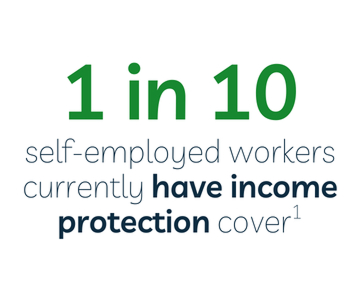
LV’s Reaching Resilience research found that 1 in 10 self-employed workers currently have income protection cover.1

Each insurer handles complex income slightly differently, so understanding those nuances is key. At LV=, your account manager can help you assess how we would view a client’s income structure before you submit the application. For your high-value clients, our specialist large case team can manage the process from start to finish – offering dedicated support, technical expertise and a smoother journey for both you and your client.

If you’re unsure, the best approach is simply to check in with us first. We’re more than happy to talk through the scenario, clarify what will or won’t be considered and help set expectations early.

How does underwriting work for income protection – especially around exclusions?

Many advisers worry about exclusions because they’ve had past cases where clients weren’t happy with the outcome. It’s understandable – nobody wants a difficult post-underwriting conversation.

That’s why it’s worth highlighting LV’s exclusion review feature. Where an exclusion is specifically stated as reviewable in the acceptance terms and policy schedule, it can be reconsidered in the future. It’s a strong reassurance for clients and a valuable selling point for advisers.

Framing underwriting as a collaborative, ongoing process, rather than a one-time decision, often helps clients feel more comfortable with the initial outcome.

document-library-files-folders-360x140-test

Protection Underwriting Guide

Our guide provides you with an overview of our current underwriting practices and the benefits of using our pre-underwriting tool.

Protection Underwriting Guide

Why is income protection so expensive?

This is one of the biggest myths in protection advice – and often stems from starting the conversation in the wrong place.

When advisers lead with price or product, clients naturally compare on cost alone. But when we begin by focusing on what income protection does – replacing the income that pays for their home, family and lifestyle if they can’t work – clients engage very differently. It becomes a conversation about quality, security and long-term resilience, not just a monthly premium.

Once the value is established, cost becomes easier to justify. And in many cases, income protection is less expensive than advisers expect, depending on the structure. It can even be more cost-effective than critical illness cover.

There are also plenty of ways to tailor the plan to your client’s budget, including:

  • Short-term payment options.
  • Longer deferred periods.
  • Personal Sick Pay (PSP) for those in higher-risk jobs.
  • Benefit amounts and policy terms that can be flexed.

When we frame income protection around the quality of the support it provides, rather than the quantity of the quote, clients are far more likely to recognise its value and see it as an essential part of their financial safety net.

At LV=, we’re committed to helping you ensure your clients can become financially resilient, and our range of Income Protection products are there to support your clients should they be unable to work due to injury or illness.

Positioning Protection: Conversation starter guide

This conversation starter guide covers questions you can ask clients to frame the need for protection, to help you have more impactful conversations.

Reaching Resilience: Conversation starters

Income Shortfall Calculator

Show your client how much income they’d lose if they can’t work. This calculator highlights the true benefit of Income Protection.

Launch calculator

Income Protection: Roadmap to Recovery

Putting Income Protection into context helps clients understand its true value. This document illustrates the recovery journey after an illness or injury – and how that experience differs with and without income protection in place.

Download document

Names and images are for illustrative purposes only.

1 LV= Reaching Resilience data 2025